Tuesday, June 23, 2020

Guest Blogger- Trainer Kristen- Reconditioning from Quarantine Life

Shout out to Trainer Kristen Sasonoff for her TWENTY guest blog entries during the past 3 months. When I asked her to begin this project, I never expected her to create TWENTY incredibly informative entries. We are so lucky to have her! Great job Kristen!

Athletic Training Blog Series #20
Reconditioning from Quarantine Life

Phase 2.5 Here we go. Things are starting to open back up, maybe you have eaten on a local sidewalk, or hit up Marshalls. Some of you have heard from your summer teams or clubs that practices and games could be coming your way soon. The Ice House is opening, and there will be leagues there this summer; baseball and softball teams have started to hit the diamonds. But wait, we have all been without a gym, practice, weight room and organized activities for months. Hopefully you have found a way to some activity during this time, I have walked over 300 miles and counting, I saw Coach Hiltz out for a run, Coach Hughes has made sure we have had plenty of opportunities through PLT4M. All those nagging overuse issues should be resolved. Are we ready for full go sports? Nope not a chance. So before I have a line socially distanced outside my room all the way to the gym, I figured I would give everyone some ideas about reconditioning back to sports and away from Tiger King and homemade bread.
  • Start SLOW- you will hate it, but your body will thank you. 
  • Weightlifting-
    • You will not be able to lift what you did in March-that’s ok
    • Drop down, start with light weight and high reps.
    • It will come back, small increases every time your back in the weight room will lead to big gains over time
  • Throwing
    • FORM FORM FORM
    • If you haven’t been throwing-limit your throws each day
    • Work on building distance-long toss helps build strength but you can’t start at 100 yards
  • Team Sports
    • DRILLS DRILLS DRILLS
      • Your skills will be rusty, this is a great time to re-learn technique
    • Small field, small group activities
    • Build up towards full field over a few weeks
  • Conditioning
    • NO ONE IS IN THE SHAPE THEY WERE IN MARCH!!
    • Start slow. Full field sprints is not the way to begin
      • Jog before running, running before sprinting
  • HYDRATE and EAT
    • When your activity level rises your body will need more nutrients than it did while binging netflix all day.
I tried to keep this very generic as every sport is starting from zero this summer. It will be SUPER important to listen to your body-and rest when you need it. As other states have started back 2 athletes have already passed away from exertional heat stroke. Acclimatization is real. Do your hardest workouts early in the morning, or after the sun starts to set-skip the middle of the day. Take breaks. Consistency will be the key to getting back to top form.  I, like all of you, am ready to roll-but if we do this slow and steady there will be less injury. And remember to follow the state guidelines. Stay socially distant, wear your mask (when not working out) when unable to be 6 feet away, and wash your hands. 


This is my last blog of Quarantine 2020. I have thoroughly enjoyed this project, and will find a way to start back up in the fall on a semi consistent basis. I hope you all enjoyed reading these. Happy Summer to all!!! If you need anything over the next few months-please reach out to me sasonoffk@cantonma.org


Monday, June 22, 2020

Turf Field Closed TODAY-TONIGHT- June 22nd

Due to Canton's annual town meeting being held on the CHS Turf tonight, the CHS Turf facility and track are CLOSED for the entire day.  

Bulldogs- remember- there are other fields in town that are actual grass! Enjoy those today! They are much cooler too!

Guest Blogger- Trainer Kristen- Barefoot running

Athletic Training Blog Series #19
Barefoot Running/Walking

Barefoot running became a craze within the last decade, which included those funny glove looking shoes vibrams. Like any fitness craze, there are some great things about barefoot running/training that can be beneficial for all athletes. Barefoot running is also called natural running, or minimalist running. It is a common practice in Latin America and Africa where our “traditional” running shoes are less available or too expensive.  
So why do folks subscribe to barefoot running, and how does it work? Running shoes have been blamed for injuries, particularly if they are not the correct shoe for your gait (walking pattern) and activity. The major premise of barefoot running is that it eliminates or minimizes the heel strike of a gait pattern which in turn minimizes the shock the tibia and fibula (long bones of the shin) have to absorb during running. Barefoot running can also use less energy over the course of the run versus shod foot running. Runners who follow this method feel as though it is much more comfortable, less painful than shod foot running. 
Like any athletic endeavor, barefoot running can lead to injuries, but they are different from shod running. Running in shoes can lead to ankle sprains, plantar fasciitis, and stress injuries. Running barefoot can also lead to injuries such as puncture wounds, heat injuries from running on hot surfaces (roads, tracks, turf), and overuse injuries. If you transition too quickly to barefoot running it can put you at increased risk for achilles tendonitis, and metatarsal stress fractures.
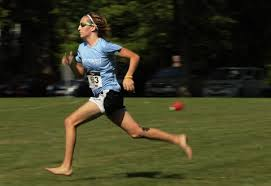
Barefoot running does have some great benefits for all athletes. The biggest is helping correct running form. This means you have a straight upper body with a slight forward lean, bent knees, relaxed feet swinging back, and a good forefoot strike under the body as shown in the image below.
Barefoot running also helps activate the plantar fascia, and muscles in the mid foot that we typically do not utilize when we run in shoes. 
There is lots of science for both sides of this argument. Which means both are helpful if used correctly. Over the years I have seen lots of success with track athletes doing their end of workout strides or cooldowns barefoot. It is a great tool in the box to help make a better athlete. If you are deciding about going completely barefoot running, start slow and transition. It will lead to injuries if you go completely barefoot for your normal mileage that you were running shod. We are heading into summer, spend time barefoot-even if it is walking around your yard, or on the beach-but I would say do your heavy training in a good sneaker. 


Thursday, June 18, 2020

Guest Blogger- Trainer Kristen- Summer Health

Athletic Training Blog Series #18
Summer Health

The nice warm sunny days are upon us (hopefully), and we will all be heading outdoors to enjoy the fresh air. After the long winter, and quarantine sitting in the warm sun feels awesome, but getting a sunburn is not awesome. So I thought I would write a few quick reminders about how to enjoy the outdoor life, while staying healthy.
Skin:
The skin is the largest organ of your body, thus we should do our best to protect it. Eating a healthy diet helps promote good skin and help prevent skin cancer. Things like mangos, tomatoes, kale, green tea, white tea, omega 3s, cocoa flavanols (dark chocolate) and soy are all foods that have great properties to help improve our skin health. Hydration is also very important to skin health, so bring that water bottle with you on your adventures. 
SUNSCREEN!! Wear it. Re-apply it! Every time you get a sunburn, the chances of developing skin cancer increase. So here are a few tips on sunscreen:
  • SPF 15 or higher for short exposures
  • SPF 30 or higher for all day adventures
  • Broad Spectrum- you want it to protect against both UVA and UVB rays
  • Apply 30 minutes before heading out, re-apply every 2 hours
  • Use 1 ounce of cream to cover your entire body
  • Even on cloudy days-the rays still get through the clouds.
  • Remember that water reflects the power of the sun-so reapply often
Eyes:
My friends will tell you my sunglasses collection is greater than my sneaker collection, and it is probably true. I mean there are 5 pairs of sunglasses in my jeep as I write this, and 2 on the kitchen table. Wearing them outside can help reduce eye strain from the brightness. Sunglasses also protect your eyes from the UV rays like sunscreen for your skin. They protect against blue light which can help prevent macular degeneration. There is also the physical protection against things getting your eye like sand, and nobody likes that. 
BUGS:
Tis the season, ticks and mosquitos are back. If you are out hiking in the woods, or walking on trails always make sure to check yourself thoroughly afterwards for ticks. Some types of ticks can lead to Lyme Disease, which while treatable, is not fun to go through. Lyme Disease and tick bites can present as a red bullseye somewhere on your skin. You may also have general joint soreness or swelling, and feel sluggish. See your MD ASAP! Then there are the mosquitos that wrecked the fall schedule this year. To avoid bites-wear bug spray with DEET or Picaridin on all exposed skin. Reduce any standing water that will allow them to nest and breed. Dawn and dusk are the worst times of day for this nuisance. If you do get bites-use can use anti itch creams like Calamine to reduce the itch. Ice also helps reduce the response. While EEE is rare- the symptoms are High Fever, vomiting/nausea, neck pain/stiffness, headache, and tiredness. They typically show up within 10 days of being bitten. See your MD if you have these symptoms.
A few last tips to have a safe summer. Swim safely. Never swim alone, especially in the ocean. Heed the warnings of lifeguards in regards to sharks and riptides. Fire pits are one of my personal favorite summer things-but fire safety is super important. Do not use accelerants, stay a safe distance away from the flame, and always make sure it is fully extinguished before leaving the scene. And if you haven’t made yourself a smore with a reese’s peanut butter cup-you should!


CHS awarded prestigious Muscato Award for 2019-20 excellence

The Hockomock League recently announced the winners of the 2019-2020 Val Muscato Award.  For the first time this century, the Canton Bulldogs were the recipient of this prestigious award.

This award is presented annually to the school who experienced the greatest athletic achievement in in each division of the Hockomock throughout all sports during the academic year.   The Bulldogs bested all other Hockomock Davenport schools en route to winning the award.

CHS Athletics has won the coveted Hockomock Sportsmanship Award many times in the past decade but this award backs up that high level of classy Bulldog play with high achievement as well.  A formula is used where the standings of each sport are tabulated and a point value is calculated from that.  It rewards the school with teams that finished at or near the top of theirs sports standings.

Leading the way to the Muscato award this year were our seven Hockomock Davenport Championship teams- Volleyball, Field Hockey, Golf, Football, Girls Swimming, Girls Hockey (Hock), and Boys Hockey.  But it wasn't just the first place teams that made this happen- as all of our teams contributed to this award by competing and succeeding in the very challenging Hockomock League.

Congratulations to Bulldogs everywhere on our Muscato Hockomock Davenport Award- 2019-20.

Check out this video of Hockomock Chairman, Tom Angelo as he shared the Muscato Award news with the Bulldog graduating class of 2020. 

Monday, June 15, 2020

Guest Blogger- Trainer Kristen- Scaphoid FX

Athletic Training Blog Series #17
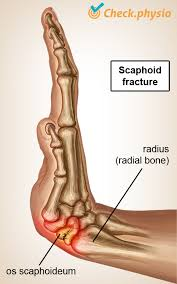
Scaphoid Fracture

The Scaphoid bone is a navicular bone in the wrist. It is one of the carpal bones that articulate with the Radius and Ulna. It can be located by holding your thumb in a “hitchhikers” position. The area or divot created by the tendons is where this bone is located.  This area is also called the anatomical snuff box. This is the area where pain and tenderness occurs if there is a fracture.
These fractures typically occur from a fall on an outstretched hand (FOOSH). There are 2 kinds of fractures in this bone. A non-displaced fracture means that the bones line up properly. A displaced fracture means that the bones are not aligned correctly. There may be gaps or multiple pieces of bone fragments. Unlike other injuries there are not any true predispositions for this injury. It can happen in car accidents, sports, or just a fall. Wearing wrist guards in sports such as skateboarding or snowboarding may help prevent it. 
Over the years, I have dealt with a few more of these injuries (including one year where we had 4 different athletes have fractures). As a result, I have learned a fair amount of tricks to help catch it. If this injury is not caught early on, the bone may not heal correctly even with surgical intervention due to the low level of blood flow to the area. Many Scaphoid fractures will first present very similarly to a wrist sprain. If there is pain in the “snuffbox” area, I will typically refer to a hand specialist. Sometimes this fracture does not show up on X-Rays until almost 6 weeks after the injury, as the bone fragments begin to die off, thus a hand specialist will be able to order an MRI or CT scan to get the correct diagnosis quickly, and start the course of treatment. 
Treatments vary depending on the fracture location and severity. If the fracture is nondisplaced and closer to the thumb, it is possible that you will only be casted or splinted including your thumb. There will be frequent x-rays to make sure that it is healing correctly. If the fracture is displaced or closer to the wrist, you may end up needing surgery. During the surgery, they will fixate the bone back together with a screw or wires. In the most severe cases, they will also do a bone graft to promote healing. Unfortunately these fractures heal very slowly-sometimes up to 6 months. Once you are out of the cast-you may need PT or OT to help regain strength and range of motion. Depending on your sport of choice you may have a splint or brace to wear to give you extra protection against repeat injury.

Thursday, June 11, 2020

Guest Blogger- Trainer Kristen- Skier/Gamers Thumb

Athletic Training Blog Series #16
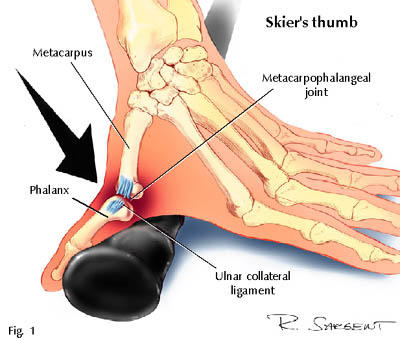
Skier/Gamers Thumb

Skier’s Thumb which can also be known as Gamekeeper’s Thumb is an injury of the Ulnar Collateral Ligament (UCL) at the Metacarpophalangeal Joint (MCP) which is where the thumb meets the hand. It got its name from the high rate of occurrence of a skier falling while still holding a pole in their hand. It is also called Gamekeeper’s Thumb due to repetitive trauma that occurs during long term gaming (Lay off the fortnight and go outside in the sunshine)
Symptoms of this injury can include:
  • Pain at the base of the thumb
  • Swelling at the base of thumb
  • Difficulty grasping objects
  • Difficulty throwing objects
  • Unstable or wobbly at the base of the thumb
  • Bruising at the base of the thumb
Athletes that use their hands in their chosen sport are at a higher risk of this injury. Thus football players, rugby players, and wrestlers can be prone to this injury since they grab at their opponents on a consistent basis.
Skier’s Thumb is diagnosed with manipulation looking for laxity (looseness) in the joint. X-Rays and MRI may also be ordered to reveal the severity of the injury. It is important to see an Orthopedic specialist or hand specialist for this injury. Many of these injuries in a less severe state can be treated non-surgically. The athlete will wear a splint, ice, and use NSAIDS as necessary. The splint will need to be worn for 4-6 weeks. If there is a complete tear of the UCL, surgery will be necessary. After surgery, the athlete will be in a cast or splint for 6 weeks. Surgical intervention is best if it occurs within a month of the original injury.
Rehab for this injury involves basic exercises. The athlete will work on Range of motion of the thumb as well as the wrist. As the ROM improves the athlete will work in grip strength. This can include ball squeezes and picking up small objects like paper clips. Once the athlete can return to sport, there is a taping that can be done to give extra support and confidence.